The wandering of Earth’s north magnetic pole has dominated headlines for years, with its run across the Arctic toward Siberia forcing regular updates to the global navigation models the world relies on. Far less attention has been paid to its southern counterpart, which has been quietly drifting in our direction.
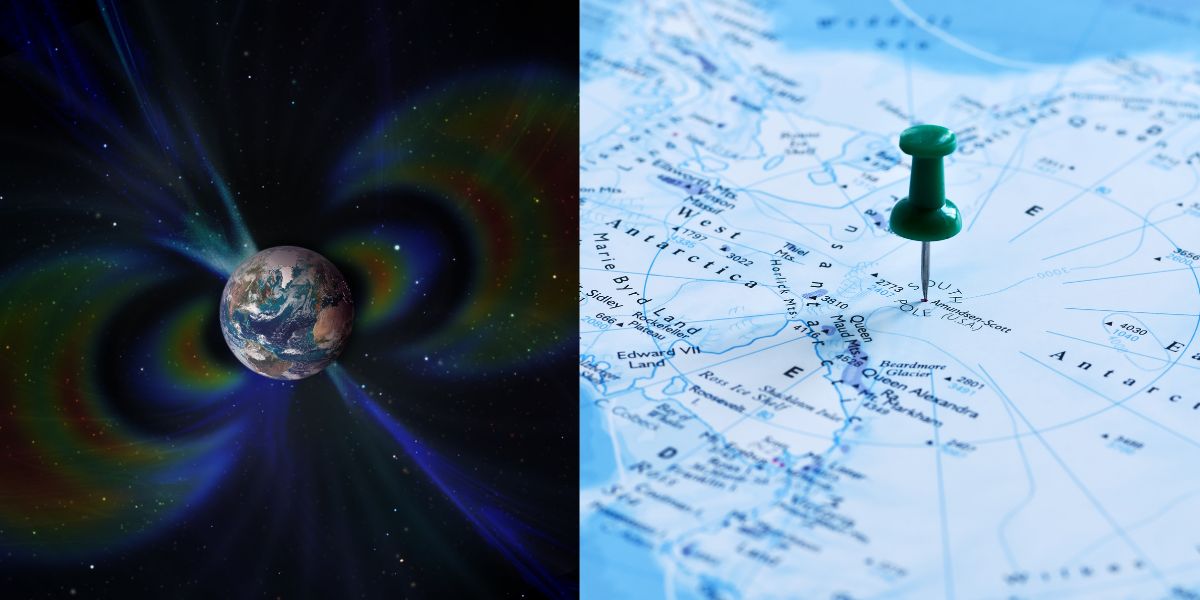
Where is the south magnetic pole now? It is no longer on Antarctica. The pole sits in the Southern Ocean at roughly 64 degrees south, off Adélie Land, outside the Antarctic Circle and about 2,800 kilometres from the geographic South Pole. It is moving northwest at roughly 10 to 15 kilometres a year, on a heading that points toward the Australian continent.
Will it ever reach Australia? Not on any timescale that matters to a human lifetime. The pole currently sits well south of Tasmania, and at its present pace it would take tens of thousands of years to approach the southern Australian coast. There is also no guarantee it will keep moving in a straight line. The magnetic poles wander in long, looping paths and have been known to slow, speed up or even reverse direction over decades.
Why is it moving toward us in the first place? The honest answer is that geophysicists are still working it out. Earth’s magnetic field is generated by the churn of molten iron and nickel in the outer core, nearly 3,000 kilometres below the surface. Data from the European Space Agency’s Swarm satellites has pointed to enormous patches of magnetic flux deep in the planet pulling the poles around in a slow tug-of-war. Why the southern half behaves so differently from the northern half — the south pole has plodded along at a fraction of the north’s speed, and did not share its dramatic sprint in the 1990s — remains an open question.
What would it be like if the pole sat over a populated region? The skies would be the obvious change. The aurora australis,currently a rare sight across mainland Australia and most often glimpsed from Tasmania during major solar storms, forms in a ring called the auroral oval that sits centred on the magnetic pole. A pole closer to populated land would mean far more frequent and widespread displays across southern Australia. The trade-off would be less picturesque. Power grids, pipelines and undersea cables in high magnetic latitudes are more vulnerable to the geomagnetically induced currents triggered by solar storms, the same phenomenon that collapsed the Hydro-Québec grid for about nine hours in March 1989, leaving roughly six million people without power. High-frequency radio communications also degrade more often near the magnetic poles.
Does this mean the poles are about to flip? The last full reversal of Earth’s magnetic field happened about 780,000 years ago, and reversals are thought to take thousands of years to play out. Scientists watching the current data say there is no credible sign one is imminent. The related South Atlantic Anomaly, a weak spot in the field that has expanded by close to the area of Europe over the past decade, does cause radiation glitches for satellites passing through it, but it is not, on its own, evidence of an impending flip.
How does any of this change the way we navigate? Most Australians will never notice. The World Magnetic Model, maintained jointly by the United States and the United Kingdom, is updated every five years to keep compasses, aircraft systems, shipping and the GPS in everyday phones aligned with the moving poles. The most recent update was released in late 2024. Surveyors, miners and aviators rely on it more directly than the rest of us, and the cycle of revisions will continue quietly as the south pole drifts our way.
The south magnetic pole will keep drifting at its own pace, and the rest of us will keep updating our maps to match. The deeper questions like why the two hemispheres behave so differently. What comes next will keep geophysicists busy for decades.